
Second or Subsequent FTA
What Is a C Bond in North Carolina?
A C Bond is bail-industry terminology commonly used when the release order shows that the defendant has already missed court two or more times in the same case. This page explains Finding 6, the additional forfeiture risk, and Raleigh Bail Bonds' approval and collateral requirements. The company must review the actual release order before confirming whether the bond will be treated as a C Bond.
C Bond Explained
“C Bond” is not the official name printed on a North Carolina release order. Bail agents commonly use the term when Finding 6 on AOC-CR-200 (Conditions of Release and Release Order) is checked, indicating that this was the defendant's second or subsequent failure to appear in the same case.
Because the surety receives official notice of the prior FTAs before executing the new bond, another failure to appear can prevent the resulting forfeiture from being set aside through the ordinary G.S. 15A-544.5 process.
Raleigh Bail Bonds may consider these bonds but requires 100% cash collateral equal to the court-ordered secured bond amount, plus the applicable premium, subject to complete review and final approval.
Which Situation Applies?
Choose the situation that best matches what is happening right now. Each option explains what the status generally means, what to verify, and the next practical step.
Finding 6 Is Checked
The release order officially indicates a second or subsequent failure to appear in the same case. Raleigh Bail Bonds must review the actual order before confirming treatment as a C Bond.
Someone Told Me This Is a C Bond
“C Bond” is industry shorthand, not an official court term. The marked release order—not a verbal label—controls. Obtain a copy of AOC-CR-200 (Conditions of Release and Release Order).
I Am Not Sure How Many FTAs Are in the Case
Review the current release order. Finding 6 applies to two or more prior FTAs in the same case. FTAs from other cases may affect underwriting but do not automatically satisfy the statute.
The Defendant Has FTAs in Different Counties
Each case and release order must be reviewed separately. An outside FTA may create a separate hold or bond requirement, but it does not automatically make the current bond a C Bond.
I Want to Understand the Collateral Requirement
Raleigh Bail Bonds requires cash collateral equal to 100% of the court-ordered secured bond amount for an approved C Bond, plus the applicable premium. The two are separate.
I Am the Cosigner
Understand the indemnity agreement, the collateral exposure, and the heightened forfeiture risk before signing. Another missed court date can place the full secured-bond amount at risk.
The Defendant Missed Court Again
The court may enter forfeiture. Ordinary set-aside relief under G.S. 15A-544.5 is prohibited when subsection (f) applies. Contact the bondsman and an attorney immediately.
I Received a Forfeiture Notice
Statutory notice and final-judgment procedures still apply. Do not assume the collateral is instantly lost, but do not assume ordinary set-aside is available. Contact counsel.
The Defendant Received a New Court Date
A new court date by itself does not restore the ordinary G.S. 15A-544.5 set-aside remedies when subsection (f) applies. Verify the actual status of the forfeiture separately.
The Defendant Was Arrested or Surrendered
Arrest or surrender does not create the usual set-aside right for that forfeiture when subsection (f) applies. The criminal case and the forfeiture are separate proceedings.
Information to Gather
- Defendant's full legal name
- Date of birth
- County where the case is pending
- File or case number
- All charges associated with the release order
- Current bond amount
- Current bond type
- A copy or clear image of AOC-CR-200 (Conditions of Release and Release Order)
- Whether Finding 5 is checked
- Whether Finding 6 is checked
- Number of prior FTAs shown in the same case
- Other cases, counties, bonds, or holds
- Current custody location
- Attorney contact information
- Potential cosigner information
- Government-issued identification
- Employment and residence information
- Source of the proposed cash collateral
- Information required to document the collateral transaction
Do not rely only on what another person called the bond. Raleigh Bail Bonds must review the actual release order and current custody information. For the complete missed-court guide, see the complete Failure to Appear guide.
Finding 6 on AOC-CR-200 (Conditions of Release and Release Order)
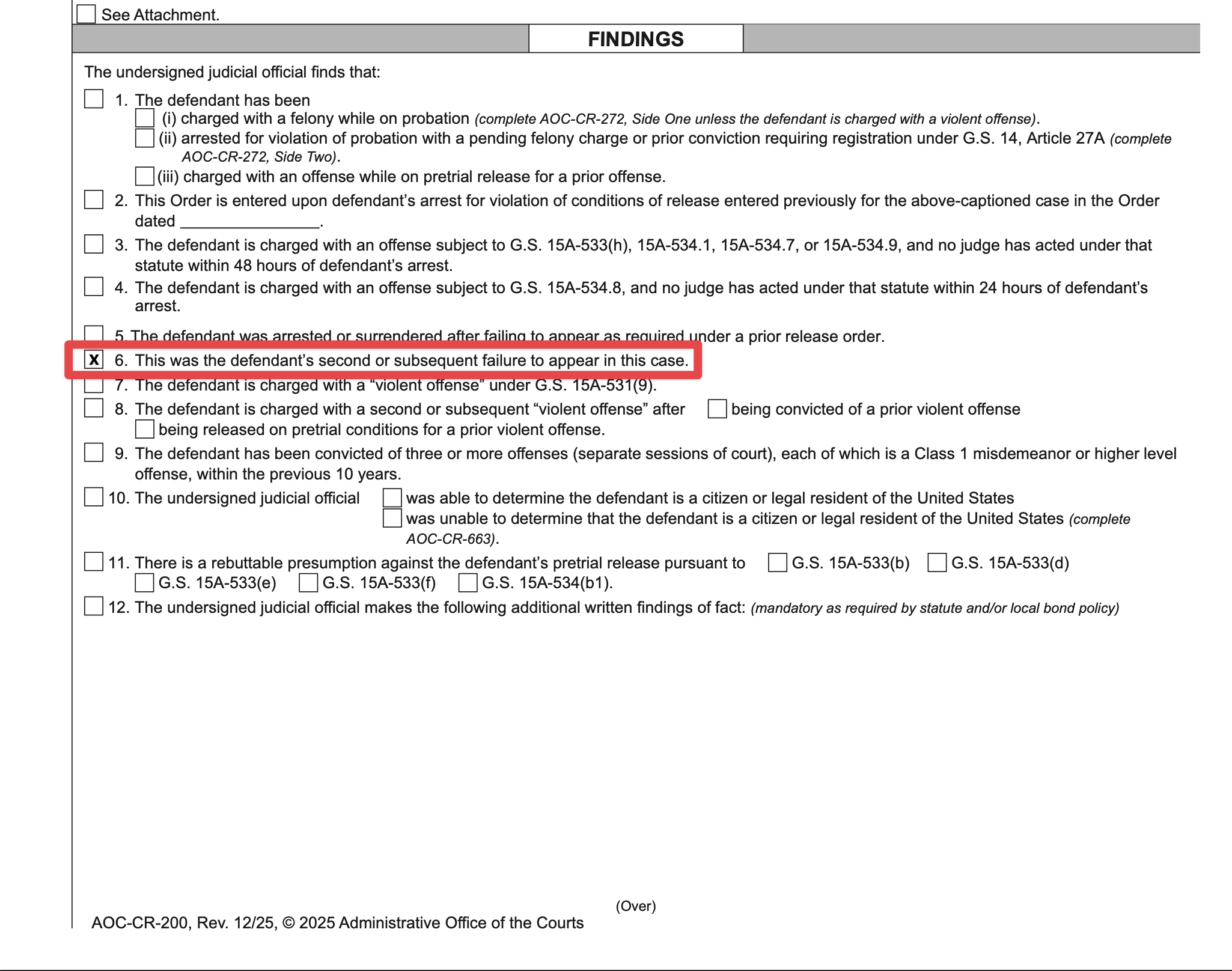
Official AOC-CR-200 "Conditions of Release and Release Order" Form — Finding 6 is checked by the judicial official to notify bondsmen of a second or subsequent failure to appear.
“This was the defendant's second or subsequent failure to appear in this case.”
— Finding 6, AOC-CR-200 Conditions of Release and Release Order
“Second or Subsequent”
The available information indicates that the defendant has already failed to appear on at least two prior occasions before the new bond is executed.
“In This Case”
The statutory consequence concerns prior FTAs in the case for which the new bond is executed. FTAs from other cases or counties may still affect underwriting, approval, and other holds, but do not automatically satisfy G.S. 15A-544.5(f) for the current bond.
“Indicated by a Judicial Official”
The release order must officially show the prior FTAs. A verbal claim by a caller or bail agent is not a substitute for the marked release order.
Finding 5 Compared With Finding 6
Finding 5
“The defendant was arrested or surrendered after failing to appear as required under a prior release order.”
Finding 5 identifies a post-FTA release. It does not necessarily make the bond what agents call a C Bond.
Finding 6
“This was the defendant's second or subsequent failure to appear in this case.”
Finding 6 is the critical repeated-FTA notice. It creates substantially greater risk for the surety.
Both findings may be checked on the same release order. For the general post-FTA bond process, see how the new bond works after an FTA.
Why Bail Agents Call It a C Bond
“C Bond” is practical industry shorthand used by some North Carolina bail agents. It is not a term defined on AOC-CR-200 (Conditions of Release and Release Order), not a separately named statutory bond category, not automatically a court-ordered cash bond, and not a universal label used identically by every agent or company.
The public should focus on:
- The marked release order
- Finding 6
- The current secured-bond amount
- Every additional bond or hold
- The written commercial bond and collateral agreement
Why Finding 6 Creates Greater Risk
Under G.S. 15A-544.5(f), no forfeiture of a bond may be set aside under G.S. 15A-544.5 when:
- The surety or bail agent had actual notice before executing the bond
- The defendant had already failed to appear on two or more prior occasions
- Those prior FTAs occurred in the case for which the bond was executed
- The prior FTAs were indicated on the release order by a judicial official
Finding 6 provides this official notice when properly marked. This limitation applies to the ordinary statutory set-aside process.
Ordinary Bond
One of the statutory grounds listed in G.S. 15A-544.5 may allow the forfeiture to be set aside when all requirements are satisfied.
Finding 6 / C Bond
The ordinary G.S. 15A-544.5 set-aside grounds are unavailable if subsection (f) applies.
What Happens If Court Is Missed Again?
- 1The defendant fails to appear as required
- 2The court may enter a forfeiture
- 3Notice is issued through the statutory process
- 4Because the release order gave notice of two or more prior FTAs, ordinary set-aside under G.S. 15A-544.5 is prohibited when subsection (f) applies
- 5If the forfeiture is not otherwise resolved through a legally available process, it may become a final judgment under G.S. 15A-544.6
- 6The surety can become financially liable for the bond amount
- 7The written indemnity and collateral agreement may affect the cosigner and cash collateral
Missing court again puts the entire secured-bond amount and cash collateral at serious risk.
The collateral is not instantly lost at the exact moment court is missed. Court forfeiture, notice, and final-judgment procedures still apply. However, ordinary set-aside relief is unavailable when G.S. 15A-544.5(f) applies. For the complete North Carolina bond-forfeiture process, including the forfeiture notice, final-judgment date, and set-aside grounds, see the dedicated guide.
Does a New Court Date Fix the Forfeiture?
A new court date by itself does not restore the ordinary G.S. 15A-544.5 set-aside remedies when subsection (f) applies.
The following should not be treated as automatic solutions:
These events may have different legal effects in other forfeiture situations, but the Finding 6 restriction must be evaluated separately. Do not make an individualized legal determination without consulting counsel.
Is There Ever Relief From a Final Judgment?
Setting Aside a Forfeiture
The ordinary pre-final-judgment process under G.S. 15A-544.5. This is the process that subsection (f) prohibits when Finding 6 applies.
Relief From Final Judgment
A separate and narrow process governed by G.S. 15A-544.8. It allows a court to consider limited grounds such as lack of required notice or other extraordinary circumstances.
- This is not an ordinary safety net
- Relief is not automatic
- Raleigh Bail Bonds does not promise that extraordinary circumstances exist
- The availability of relief must not be used to minimize C Bond risk
- Legal questions about final-judgment relief should be handled by qualified counsel
Our Requirements for a C Bond
Raleigh Bail Bonds may assist with a C Bond after reviewing the complete case, release order, current bonds, holds, defendant information, and cosigner information.
For an Approved Bond Treated as a C Bond (Finding 6 Checked):
- Cash collateral equal to 100% of the court-ordered secured bond amount is required
- The applicable bail bond premium must be paid in addition to the collateral
- The collateral and premium are separate
- Complete documentation is required
- The source and form of funds must be acceptable
- Approval is not guaranteed
- Funds should not be submitted until the company has reviewed the case and provided written instructions
- All obligations must be explained in writing before signatures or payment
Example
Court-Ordered Bond
$10,000
Required Collateral
$10,000
Premium
Separate fee
The 100% cash-collateral requirement is Raleigh Bail Bonds' company policy. It is not a Wake County court requirement, not a North Carolina statutory requirement, not necessarily the policy of another bail company, and not the same as paying a court-ordered cash bond directly to the court.
Cash Collateral Versus a Court Cash Bond
Cash Collateral Provided to Raleigh Bail Bonds
- Secures the bail bond company's financial exposure
- Is governed by the written commercial bond and collateral agreement
- Must be handled according to North Carolina collateral requirements
- Is separate from the premium
- Does not replace the commercial bond executed by the bondsman
Court-Ordered Cash Bond
- Is a release condition imposed through the court process
- Generally requires the applicable cash amount to be deposited through the court or detention process
- Does not involve Raleigh Bail Bonds writing the same commercial surety bond
A caller should verify whether the release order shows a secured bond, cash bond, no bond, judge review, or another type of release condition. Do not describe these arrangements as interchangeable.
How Cash Collateral Must Be Handled
When collateral is accepted:
- A detailed written receipt must be provided
- Collateral must be held and maintained in trust
- Cash, checks, or negotiable instruments accepted as collateral must be deposited within the legally required period into an established, separate, noninterest-bearing trust account in a North Carolina bank
- Collateral funds must not be mixed with ordinary operating funds
- Collateral must be reasonable in relation to the amount of the bond
- Collateral that remains returnable must be returned within the period required by current law after final termination of liability on the bond
Do not assume collateral will be returned merely because:
- The defendant is released
- The next court date passes
- The case appears inactive
- The defendant is arrested after an FTA
- A new court date is issued
The bond company's liability must be formally terminated and any contractual obligations must be resolved. See G.S. 58-71-95 and G.S. 58-71-100.
When Can Collateral Be Returned?
Cash collateral is not a payment toward the premium and is not automatically consumed when received. Returnable collateral is generally held while the bond company remains liable.
Before returning collateral, the company must confirm:
- The court has formally terminated liability on the bond
- No unresolved forfeiture or final judgment remains
- No applicable contractual obligation remains unpaid
- The person requesting return is legally entitled to receive it
- Required documentation is complete
North Carolina law requires returnable collateral to be returned within the applicable statutory period after final termination of liability. Not every case ends on the same date, and collateral cannot always be released immediately after the criminal charge is resolved.
What the Cosigner Is Accepting
Before Signing, the Cosigner Should Understand:
- Finding 6 indicates repeated FTAs in the same case
- Another missed appearance creates exceptional forfeiture exposure
- Ordinary set-aside relief may be prohibited
- The premium and collateral are separate
- The collateral may remain held while the bond company remains liable
- The full secured-bond amount may be at risk
- The indemnity agreement can create repayment obligations
- The defendant must attend every required court appearance
- Address, phone, employment, and court information must remain current
- The cosigner should immediately report concerns about another possible FTA
- Every document should be read before signing
Do not pressure the visitor to sign quickly without understanding the obligation. For a detailed breakdown of cosigner responsibilities, see the responsibilities of a domestic violence bail bond cosigner and the general post-FTA bond guide at bond after missing court.
Why Raleigh Bail Bonds May Decline a C Bond
Even with 100% cash collateral, approval is not automatic. The company may evaluate:
- The marked release order
- Number of prior FTAs
- Total secured-bond amount
- Other active bonds
- Other counties or warrants
- No-bond entries
- Probation or pretrial-release status
- Ability to maintain contact with the defendant
- Defendant's residence and employment
- Cosigner cooperation
- Accuracy and completeness of the application
- Source and documentation of collateral funds
- Additional underwriting requirements
- Whether the company can responsibly manage the risk
The company does not imply that the defendant is guilty or dishonest merely because Finding 6 is checked. Approval decisions are based on underwriting criteria and the company's ability to responsibly manage the risk.
Multiple Cases, Counties, and Release Orders
A defendant may have:
- Finding 6 checked in one case
- A first FTA in another case
- An Order for Arrest from another county
- Different bond conditions for separate charges
- A no-bond entry
- A probation-related hold
- A DWI or domestic-violence release condition
- A federal or other agency hold
Verify Every Case Before Providing Funds
Posting the C Bond may not produce release when another bond, hold, or judicial condition remains unresolved. Every case and release order must be reviewed separately. For the general post-FTA process, see how the new bond works after an FTA.
What a Bondsman Can and Cannot Do
A Licensed Bondsman May
- Review the current release order
- Confirm whether Finding 6 is checked
- Explain why the company treats the bond as a C Bond
- Review the secured-bond amount
- Check for other publicly available bonds and holds
- Explain premium and collateral requirements
- Review cosigner information
- Provide a written collateral receipt and agreement
- Post an approved secured bond
- Confirm when the bond has been submitted
- Explain the company's court-date and contact expectations
A Bondsman Cannot
- Remove Finding 6
- Change the release order
- Strike an FTA
- Recall an Order for Arrest
- Reduce the court-ordered bond
- Remove an outside hold
- Guarantee approval
- Guarantee release
- Guarantee an exact release time
- Guarantee that a forfeiture will be avoided
- Guarantee relief from a forfeiture or final judgment
- Provide criminal-defense advice
What to Do Before Starting
For immediate help from a licensed Raleigh bondsman, call with the release order and defendant information. For the broader county process, see Wake County bond and release information.
- Obtain the current release order
- Confirm that Finding 6 is checked
- Verify the secured-bond amount
- List every additional bond and hold
- Confirm the defendant's custody location
- Contact the criminal defense attorney about the case
- Prepare complete cosigner information
- Prepare identification and source-of-funds documentation
- Review the 100% collateral requirement
- Confirm that the premium is separate
- Read the written indemnity and collateral agreements
- Ask how court dates will be monitored
- Do not provide funds to an unverified person or without written instructions
After Release on a C Bond
- Read every release condition
- Obtain the official next court date
- Confirm whether personal appearance is required
- Save the date in multiple calendars
- Set reminders well in advance
- Verify the date again shortly before court
- Keep the attorney informed
- Keep Raleigh Bail Bonds informed of current contact information
- Report address or employment changes
- Follow travel, residence, monitoring, testing, and contact restrictions
- Do not assume a continuance has been granted without official confirmation
- Contact the attorney immediately if an emergency could affect attendance
- Attend every required court appearance
Preventing another FTA is the most important responsibility after release.
Helpful Resources
Failure to Appear
Complete guide to FTAs, Orders for Arrest, new bonds, forfeiture, and second FTAs.
Failure to AppearOrder for Arrest After Missing Court
Check whether an Order for Arrest exists, understand recall requests, and learn when a bondsman may help.
Order for Arrest After Missing CourtBond After Missing Court
Verify the new secured bond, understand what commonly happens in Wake County, and prepare payment or collateral information.
Bond After Missing CourtBond Forfeiture
Read the forfeiture notice, understand the final-judgment date, and identify the limited statutory set-aside grounds.
Bond ForfeitureWake County Bail Process
Complete county-level bond process and release information.
Wake County Bail ProcessWake County Detention Center
Custody, booking, and release information for the Wake County jail.
Wake County Detention CenterBail Bond Payment Options
Flexible payment options for qualifying bonds.
Bail Bond Payment OptionsSecure Online Application
Start the secure online application.
Secure Online ApplicationBail Bond FAQs
Complete bail bond questions and answers.
Bail Bond FAQsFrequently Asked Questions
Need Help With a C Bond?
Call Raleigh Bail Bonds with the defendant's full legal name, date of birth, current custody location, charges, file numbers, and a copy of the release order if available. We can confirm whether Finding 6 is checked and explain the required cash collateral and premium.
Last reviewed: August 2026 — Reviewed by a licensed North Carolina bail bondsman.
This page provides general information about bail and pretrial release. It does not provide legal advice or predict the outcome of a particular case. “C Bond” is bail-industry terminology, not an official court term. The 100% cash-collateral requirement is Raleigh Bail Bonds' underwriting policy, not a court or statutory requirement.